
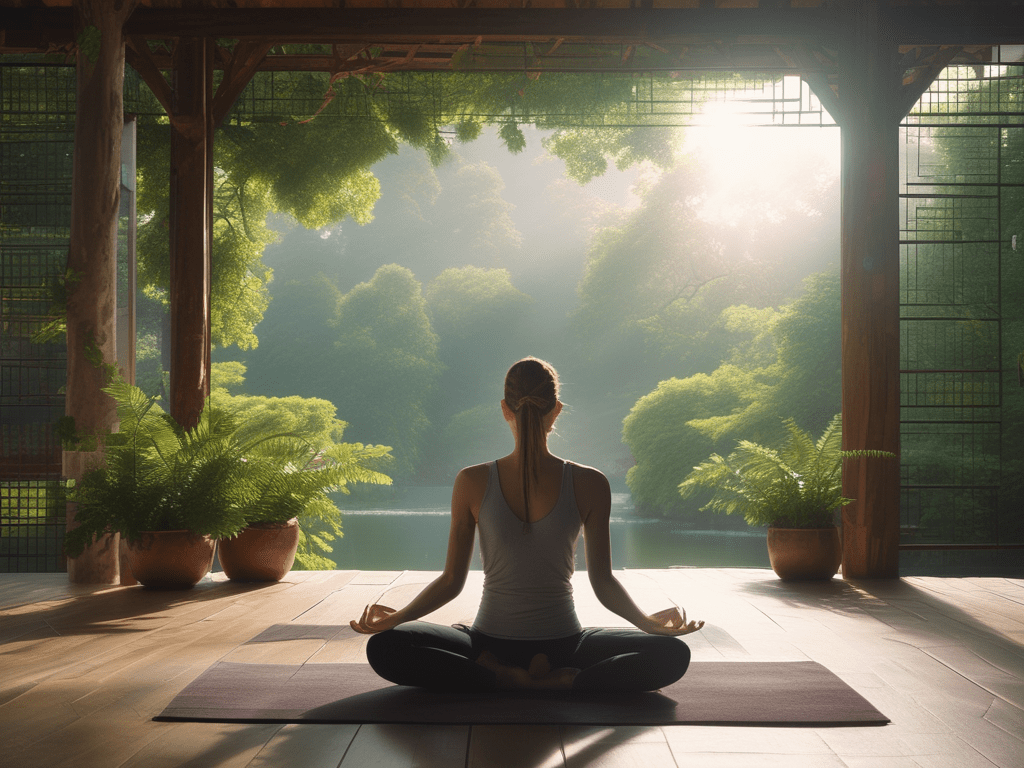
What is integrative health and which are the benefits when you integrate it into your life?
It’s nothing else than a holistic approach to your health which compared with the traditional medicine is like you are looking for a global solution rather than a cure in an isolated part of your body. All the cells of our body work like a cooperative model, helping each other to get their targets and when we concentrate only in one part avoiding the rest, we carry over the risk to reoccur the problem again in the future because we are not attacking the root cause.
This holistic approach drives you to harmonize your physical, mental and emotional systems in a collaborative way, being all part of a superior entity, your health.
Just an example to illustrate you…, running, being one of the most practiced sports today, wouldn’t be as effective if we run meanwhile, we think what’s the next duty waiting for us after finishing our preferred sport. However, this will become an effective practice if we focus on it while we are practicing, concentrating our mind on each breath, each step, and each heart beat. By balancing body and mind, we automatically balance our emotional part.
What are the benefits of integrating it into your work?
If our personal life is balanced, we also notice that at our workplace. We have less risk of suffering stress and in the worst case, preventing possible burnout. The employer should be supportive as well as this reduces the absenteeism rate. Our performance will be much better, increasing the confidence and satisfaction of both employees and employers, which will help to create a better environment in the workplace.
And how can we be healthier following this approach?
Basically, changing our bad habits to healthier habits. It’s not easy at the beginning but there is a rule saying if you keep doing the same recently acquired habit for at least 21 days, then you’d have achieved and integrated it into your routines.
Let’s see what are the six highly recommended habits that can change your life.
1. Healthy eating
Recent studies looked at the eating style in the blue zones, or areas concentrating most of the old aging people in the world surpassing the hundreds in age, like Okinawa in Japan or Sardinia in Italy. Surprisingly, it’s not all about having a balanced diet, eating a little bit of everything but also incorporating to our lives other practices like physical activity and social commitment, what in Japanese is called the ‘ikigai’. We’ll talk later about this concept.
This could be too long a chapter if we want to deep inside, but some tips can guide you and make think about to find out more.
- Add all colors to your meals.
- Decrease the frequency of the intakes.
- Practice daily intermittent fasting, at least for 12 hours.
- Avoid ultra-processed food and minimize sugar/salt/caffeine/alcohol.
- Consider taking food supplements.
- 2. Take care of yourself
Since we are living separated from nature, in jungles made of steel and concrete, our circadian cycle has been changed because you never see the dark in a big city which makes your body feel you are living constantly in a light day, similar to what happens in the poles where they have 6 months of permanent light and 6 of dark.
Our neanderthal ancestors woke up at dawn and slept at sunset. Our genetics hasn’t changed so much since then, but technology indeed has done. That means we are not well adapted yet to the new reality and our bodies notice this. It’s the same effects the jet lag provokes in your body. This is why is so important to sleep at least 7 or 8 hours and the quality of your sleep matters.
Few more tips on this habit:
- If you are an owl, try to become a lark.
- Sleep well as this is when your body recovers your systems like a software backup.
- Expose yourself to the first and last day sunbeams, the orange beams are better than the whites and safer than the midday ones. This will give energy to your body.
- Take time for yourself, relax and practice digital disconnection, at least during weekends.
- 3. Physical activity
Our body has been designed to move, so for all of us who have sedentary work, it’s so important to invest some time to practice exercise, energizing our body and building a better musculoskeletal system. It’s an important habit to improve our metabolic flexibility combined with good nutritional practices. If you don’t have enough time, that’s not an excuse as 15 mn high level intensity activity like a HIIT (High Intensity Interval Training) each day from Monday to Friday will be sufficient. And another very good practice is walking 30 mn after your main lunch.
At your workplace is highly recommended to stand up at least every hour and walk around for few minutes. If that’s even impossible because of our multiple meetings concatenating one after the other, then stretching your legs and arms is also so valid.
- 4. Exposure to toxics
Don’t be threatened by your own mind. Most of the time we are caught fearing the future or regretting the past rather than focusing the present when this is the time where you can define your actions so don’t worry too much on what’s not possible to act and concentrate here and now.
Epigenetic factors are more important than genetic ones which means we can improve so much our health by adopting some healthy good habits like avoiding exposure to toxics. For instance, it’s better running in a park than in a crowded street at rush time in a big city or it’s good if I’m controlling the number of glasses of wine I’m drinking in a week.
The main problem is recognizing what is a toxic and what’s not. Of course, everybody knows that drugs, cigarettes, and alcohol are harmful for our body, but what about the hidden and still well accepted by our society like sugar, caffeine, or ultra-processed foods?
Social media can be also a toxic if you are not managing it well.
- 5. Emotional Management
How many times have you caught yourself without breathing properly when reviewing emails or working with data sheets at your workplace?
If that’s also your case, the first step is just to realize it so you can take a simple action which is stop for a minute and do some breath exercises like a couple of deep inspirations/expirations. As simple and effective as that. And of course, keep doing it from time to time. If you can combine this exercise with some neck, ankles and wrists movements it’s even better.
But the most powerful technique to fight against stress is of course, mindfulness. I really aim for all of you to try it if you haven’t done it yet.
- 6. Social Interaction
Have you ever heard about the tribe concept? Do you remember the ‘ikigai’ in the first recommended habit? ‘Ikigai’ means ‘the purpose of your life’.
We are all part of a community, not an isolated part of human beings, and all have our own ‘ikigai’. We are like the musicians playing in an orchestra, interpreting the song of our lives. Each one of us is important and we work like a team. That’s why human beings have grouped in societies since always. Feeling us part of this society helps to keep us healthier as our life has a purpose.
And the last but not least, our DNA belongs to nature, not to artificial ecosystems. So, stay connected all the time you can with mother nature. Just walk in the forest with your friends and family and take forest baths to recharge your batteries. Now, you may wonder how I can integrate all this into my day-to-day life. Well, it’s good to take a quiet time to reflect and run an assessment on your current profile, so rate yourself from 0 to 10 in each of the talked habits to know where are your improvement areas, knowing that never we are going to have a round circle at the level of 10, but that’s not necessary because nobody’s perfect and willing to be all the time at the top of everything will only generate more stress.
 Joan Arqué